|
|
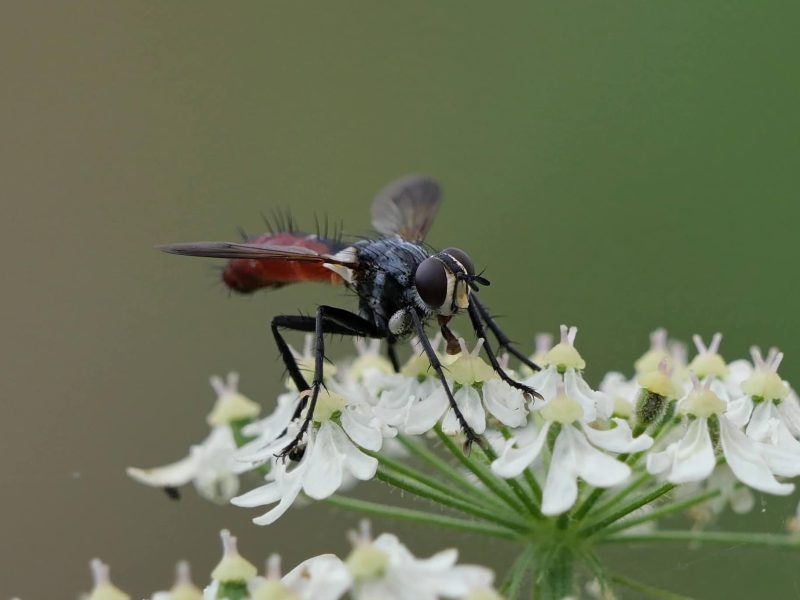
Welcome to the new TRS website – a one-stop-shop for anyone interested in studying UK tachinid flies. The site has the very latest news & information from the recording scheme plus the most up to date species list and key updates.
Currently the Species Accounts page allows you to search for anything on the British list; view the data we hold on it, including excerpts from all of the major works; view any photos we have of specimens or insects in the field; and also to link to the NBN mapping database, which currently hold 15,000 of our recording scheme records plus records from other regional and national recording projects.
Linnaemya picta was added to the British list fairly recently but has been found in a few localities this year – namely Kent, Suffolk & Cambridgeshire. There was also a suspected record from the Reading University grounds but this wasn’t confirmed beyond doubt. So it is worth noting that the male genitalia are particularly distinctive, with the characteristic curved and spoon-shaped tip:
 Linnaemya picta (male, genitalia, x4 magnification)
 Linnaemya picta (male, genitalia, x3.5 magnification)
This is a photograph of a Tachina grossa wing, annotated to show the commonest features that are used in the keys:
I always orient myself by looking for the smallest vertical vein called r-m, the little one in the middle – it links the last true radial vein (r4+5) to the median. The median vein is probably the most important in tachinids because it often bends in different ways and either joins or doesn’t join r4+5. If the median vein joins r4+5 before the wing edge then it forms a small stalk called the petiole (not on this photo). Sometimes the bend has a little stalk (appendix – not in this photo) or crease that extends towards the wing margin. If you go up from r4+5 the next radial is r2+3 and these 2 veins meet together, near the body, at another important areas called the node. The node has varying numbers of hairs on it and sometimes these hairs extend along r4+5 towards or even beyond r-m. Above r2+3 you will see r1 and then to the left sc, the sub-costal vein. Along the leading edge is the costal vein (annotated in sections – CSx) – these sections are of varying relative lengths and this can be important. The last section (CS6) extends to a notional point that is the tip of the wing. Below the median vein the next radial is called the cubital vein and it is linked to the median by m-cu. The point where m-cu joins the median is important in some species, as is the length of the section of the cubital beyond m-cu. The final vein that is of interest to us is the anal vein – we are usually just asked to see whether it extends to the edge of the wing, but watch out – make sure that it isn’t just a crease that meets the wing edge!
Here are a few of my latest stacks showing some nice tachinid head close-ups. Most were all taken using the Nikkor EL 50mm f2.8 lens reversed on bellows
-
-
Allophorocera ferruginea (male, x2.3)
-
-
Beskia aelops (x3.5, French Guiana)
-
-
Billaea kolomyetzi (male, x2.3)
-
-
Bithia demotica (male, x2.3)
-
-
Bithia demotica (male, x2.3)
-
-
Borgmeiermyia sp (male, x4 – using a Schneider Componon 35mm f5.6)
-
-
Chrysocosmius aurata (male, x4 – using a Schneider Componon 35mm f4)
-
-
Chrysotachina sp. (x3.5, French Guiana)
-
-
Gymnocheta viridis (female, x4 – using a Schneider Componon 35mm f5.6)
-
-
Linnaemya vulpina (male, x3.7 – using a Schneider Componon 35mm f4 at 75mm)
-
-
Pelecotheca (Cryptocladocera) (male, x3.7 – using a Schneider Componon 35mm f4 at 75mm)
-
-
Phyllomya volvulus (male, x3)
-
-
Prosena siberita (female, x3)
-
-
Telothyria sp. (male, French Guiana, x4 – using a Schneider Componon 35mm f5.6)
Today I test-drove my first proper stacking system:
- Canon EOS 1000D (actually a Canon-refurbished Rebel/Xs)
- Tamron 90mm f/2.8 SP Di lens
- cheapo adjustable Yongnuo YN560 Chinese flash
- cheapo Chinese Fotomate macro rail
- a plastic cup, some foam & one of those sticky rubber mats that they sell to stop rugs moving on laminate flooring.
The exposure is set on f8 @ 1/125th (100 ISO) and the flash is being run off a PC-PC cable in manual mode, turned right down to the lowest power level. The lens has a little electronic fault that prevents it being focused at 1:1 but it will work at just less than that. The sticky mat just prevents any of the equipment sliding on the table and it keeps everything remarkably stable.
The results are really nice … to my mind anyway. The light needs balancing and the sharpness needs improving but it is getting there and these really are the first proper stacks I have ever done.
A couple of days ago I received an interesting parcel from Chris Bentley, the warden of Rye Harbour NR. Chris is a keen Dipterist and had turned up some fantastic records in the past – namely the Brown-tail parasitoid Townsendielomyia nidicola and the extremely rare Huebneria affinis – so I always look forward to receiving something from him. He had pre-warned me that he had some suspected Erynnia ocypterata and some Carcelia that he couldn’t quite place and suspected atricosta, which is one of the rarest species in that genus (gnava and laxifrons possibly being slightly rarer species).
Anyway, the Erynnia ocypterata were fairly easy to identify and confirm … this is an incredibly rare species in the UK, with only a handful of post-1950 records (Mike Howe & Ivan Perry). Chris’s specimens were seen “buzzing round a gatepost below a large willow … on grazing marsh with ditches” in the Rye area of Sussex.
The Carcelia were a little bit fiddly because they’re not the easiest genus to identify – the species are quite clear-cut but you do have to be able to measure the frons-width with a graticule to be quite sure, and male genitalia are very useful so these must be extracted during the pinning process (as with all calyptrates really). In these there had been some damage/flattening to the bristles on tergite-4, which had confused Chris and sent him the wrong way. On close examination they actually proceeded fairly easily to Carcelia laxifrons and the frons/genitalia backed up the ID nicely.
Carcelia laxifrons is a specialist parasitoid of Brown-tail moth (Euproctis chrysorrhoea) and, as such, it’s distribution is restricted to areas with a good concentration of the host (one might expect southern counties, especially coastal areas). In fact the species has only been recorded from the Rye area and a few other sites and was so overlooked that it was only added to the British list a few years ago – see “Carcelia laxifrons Villeneuve (Tachinidae) new to Britain and a revised key to the British Carcelia species” (Raper, Smith & Gibbs, 2004).
Many thanks to Chris who donated the specimens and filled 2 important gaps in my reference collection and to Malcolm Storey (http://www.bioimages.org.uk/) who did the photo stacks!
The species accounts can be found here: Carcelia laxifrons and Erynnia ocypterata.
Linnaemya picta was added to the British list in the last few years, starting first in Kent and then being found in Suffolk. Ivan Perry has reported some in his garden in Cambridgeshire and Steve Downes has found a lot in Suffolk this year, so it seems to me on the move and spreading in force.
Recently a suspected L.picta was photographed in the Reading University area but, tantalizingly, a specimens wasn’t taken so we can’t confirm it … yet! So keep your eyes open for Linnaemya that look like tessellans (black legs) and check every one against the amended key in the above article.
Leucostoma are little black tachinids with very large white calyptrae – usually found in southern Europe this is a very rare genus in the UK. Leucostoma anthracinum is fairly easy to identify though from the other UK species because tergites 4-5 are dusted.
Key to the genus Leucostoma
Small dark flies with large, white calyptrae.
1. Abdomen black, shining and undusted ……….. simplex Fall.
- Abdomen dark brown with segments 4 & 5 dusted ………………… anthracinum Meig.
This species was discovered by Steve Falk and was confirmed when the specimen was shown to us in 2010.
This species is still only known in the UK from the 2 specimens Steve Falk picked up in the South Downs (I think!), though it is very common in southern Europe.
Key to the genus Cylindromyia
1. Hind tibia without posteroventral bristles [Scutellum with 3 pairs of marginal bristles; 9-11mm in length, abdomen without median discal bristles on segments 1+2, 3 and 4] …….. brassicaria (F.)
- Hind tibia with 1 or 2 posteroventral bristles ………………………… 2
2. Apical scutellars absent so 1 pair of scutellar bristles [6-8mm in length; abdomen with median discal bristles on segments 1+2, 3 and 4] ……………………….. interrupta (Meig.)
- Apical scutellars present so 2 pairs of scutellars bristles [8-10mm in length; abdomen usually with median discal bristles] ……………… auriceps (Meig.)
This is another of Ivan Perry’s discoveries and is really rather exciting – a bit more than your average ‘new to the UK’ species because it is incredibly rare even in mainland Europe too. The species seems to be commonest in Eastern Europe but wherever it occurs it is very rare … Peter Tschorsnig (the foremost European tachinid expert) had records for about 25 in the whole of Europe!
There are no common members of the genus Opesia but, just in case you stumble upon on, grandis will key to Opesia cana in Belshaw so modify it thus:
1. Thorax before the suture with three black middle stripes (in males often merged, in females, the central stripe is sometimes only faintly visible). Basicosta black-brown, like tegula. Calyptrae white (males) or faintly yellowish (females). Two katepisternal (= sternopleural) bristles (seldom 3, very seldom 1). Frontal bristles in males accompanied by 15 – 20 hairs, which are only a little shorter than the frontal bristles. Females: sternite 7 (shiny black) shorter than sternite 6 ……………………………………………. cana (Meig.)
- Thorax before the suture with two widely spaced black middle stripes. Basicosta clearly lighter than the tegula. Calyptrae yellow. Three katepisternal bristles. Frontal bristles in males only accompanied by 4 – 8 short hairs. Females: sternite 7 much longer than sternite 6 ……… grandis (Egg.)
|
|